
I want to tell you about the camel first.
My guide arranged it as a tourist experience near the pyramids at Giza — the silly photographs, the desert backdrop, the whole production. What he did not arrange was accompaniment. The camel handler led me out into the open desert, away from the crowds, away from my guide, away from anyone I knew, and then stopped.
He wanted more money to take me back.
I knew intellectually that this was a standard tourist shake-down. I knew he almost certainly would have taken me back regardless. I knew none of this was genuinely dangerous.
I was still afraid. I didn’t know how to ride a camel. I had no idea which direction led back. There was no one to help me if this went sideways. I paid the $20, felt the particular humiliation of knowing you’ve been played and having no good alternative, and did not separate myself from my guides like that again for the rest of the trip.
A retired Lieutenant Colonel. A program manager of billion-dollar systems. Stranded in the Egyptian desert by a camel and a $20 shakedown.
There is a specific kind of smallness that comes from being out of your depth in someone else’s environment. I had felt competent all morning. The desert removed that in about four minutes.
———
But that was a different kind of small than what came later at Karnak.
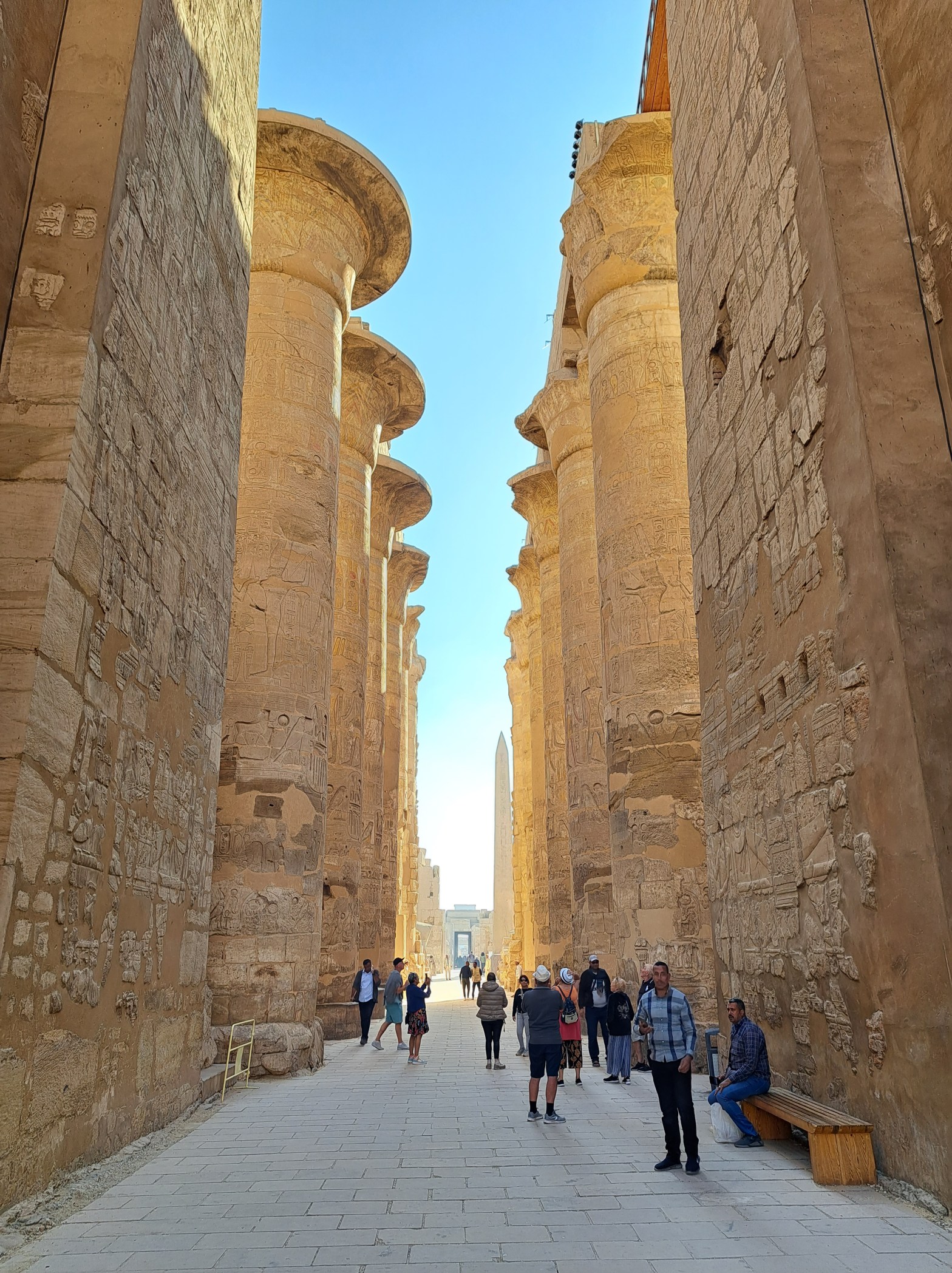
When I walked through the entrance to the main temple complex at Karnak in Luxor, I thought of a scene from a film I watched as a child — Atreyu entering the Valley of the Southern Oracle in The Neverending Story. A small figure moving into a chasm so vast and ancient that his size simply stops mattering. The avenue of sphinxes lining the approach. The walls rising on both sides to a height that made the open sky above feel like a narrow crack of light.
I was a speck. Not a small person — a speck. The distinction matters. A small person still registers. A speck does not.
One stone dropping from those walls would have ended me without ceremony.
I walked on sand. The same sand, more or less, that had been accumulating here for millennia — rising century by century until windows became doors, until doors became buried, until the entire complex disappeared beneath the surface and was simply gone from human view for a thousand years. The sand did not destroy the columns. It absorbed them. And when excavation began a century ago and the sand was finally removed, the columns were still there. Exactly where they had always been.
Still standing in the same coordinates where priests had performed rituals, where kings had scratched out each other’s names, where Christians had converted pharaonic temples into churches, where Muslims had converted those churches into mosques — each civilization rewriting the walls, none of them moving the stones.
I thought about my own work. Satellites I helped design and deploy. Rockets. Systems that cost billions and took decades. Precise, capable, extraordinary by any modern measure.
And fragile. Profoundly fragile. The smallest deviation — a temperature variance, a micrometeorite, a software error — renders them inoperable. We built redundancies upon redundancies because we knew how easily they could fail.
These columns were not designed with redundancies. They were cut from stone and stood up and left there. And they are still standing after three thousand years of everything the world could do to them.
———
There are two kinds of smallness I have now felt in my life.
The first is the smallness of being out of your depth — competence stripped away by an unfamiliar environment, no guide in sight, a camel handler waiting for his $20. That smallness is uncomfortable and instructive. It tells you where your actual edges are.
The second is the smallness of standing inside something so far beyond your scale that your accomplishments simply stop being the relevant unit of measurement. That smallness is not uncomfortable. It is clarifying.
At Karnak I left my footprints in the sand. Small ones. The wind will have erased them within days.
The columns did not notice. But I did.
What has made you feel genuinely small recently — and what did that smallness teach you?

 Talenton