Decision Under Incomplete Information

The next morning I heard about the strikes.

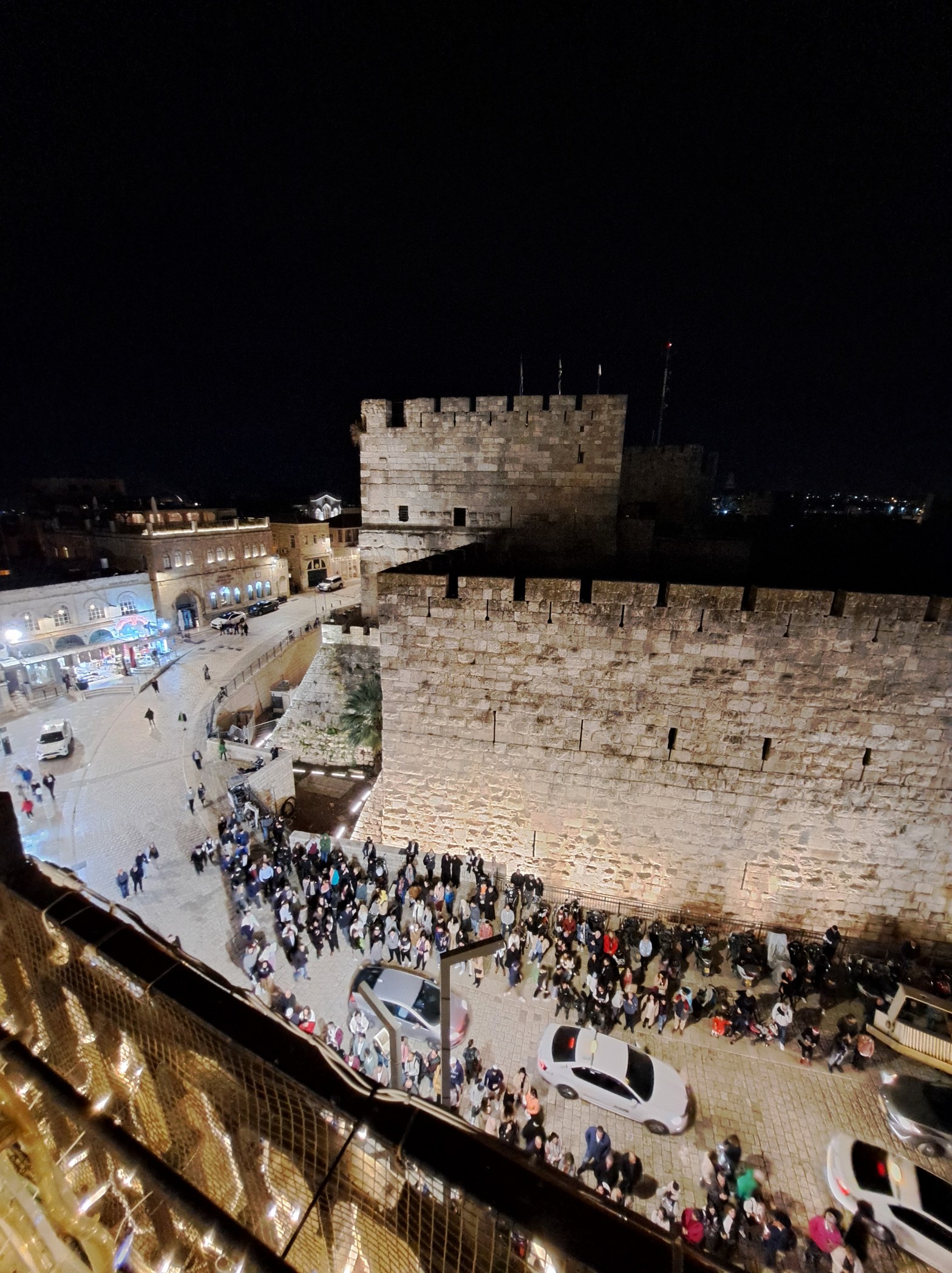
National strikes across Jordan. Protests against petrol prices. The highway between Petra and Amman — the only reliable route — was going to close. My flight to Tel Aviv left from Amman. The border crossing into Israel from Petra was open at unpredictable intervals. There was no certain alternative.

I made a decision within the hour: I was leaving that day. Whatever it took.

Something shifted when I made that call — a gear engaging, clean and automatic. Thirty years of military training doesn’t make you fearless. It doesn’t eliminate uncertainty or guarantee the right outcome. What it does is give you a framework for making a decision when the information is incomplete and waiting for clarity is its own kind of risk.

I worked with my hotel owner. We assembled a small caravan — a couple of taxis, a handful of tourists with the same problem — and we left Petra before the highway closed.

In hindsight, it may not have been as dire as it felt in the moment. I probably could have found another way. But I didn’t know that then, and waiting to find out carried a cost I wasn’t willing to pay. Sometimes the right decision and the certain decision are not the same thing. You choose anyway and you move.

———

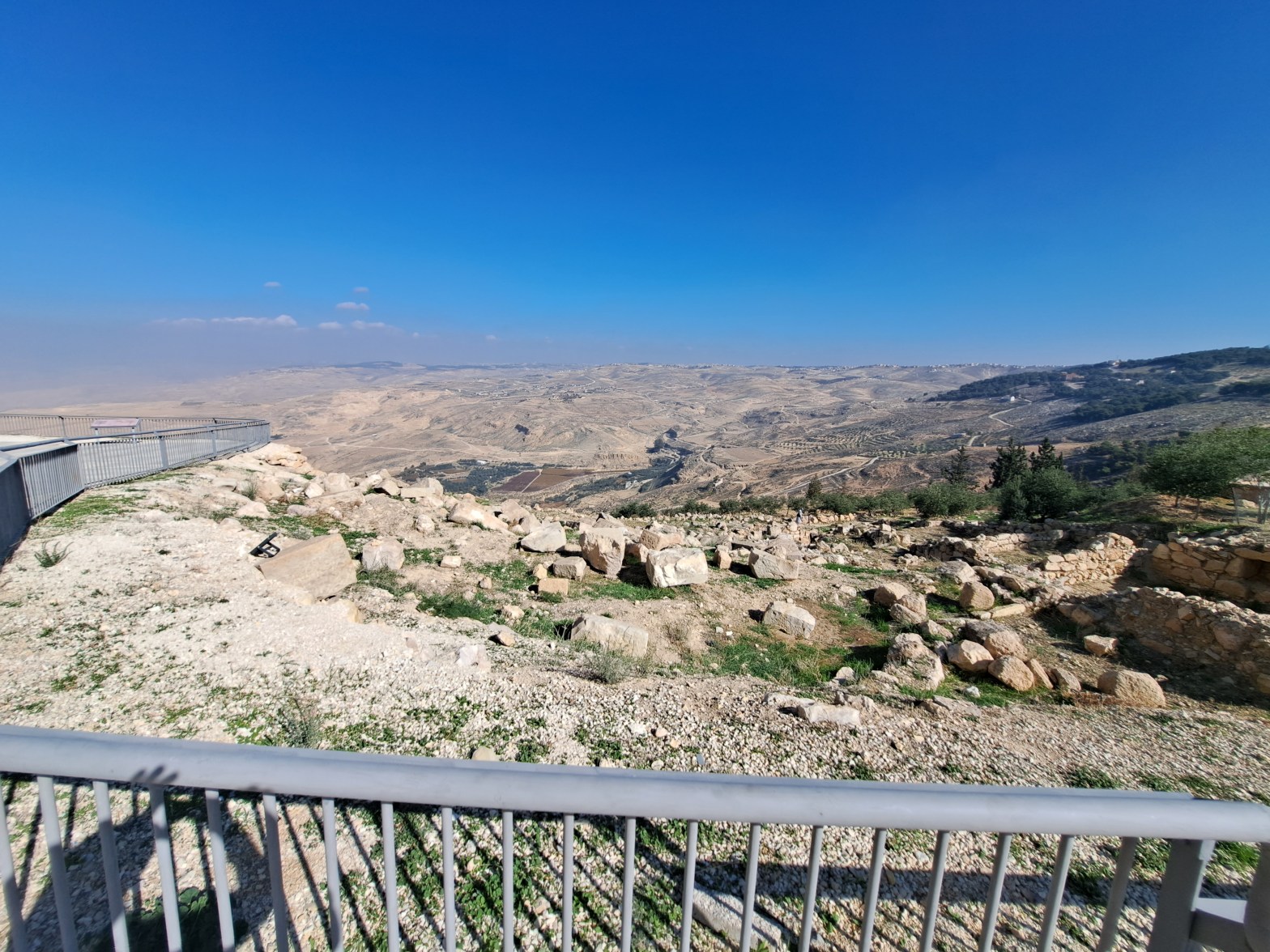
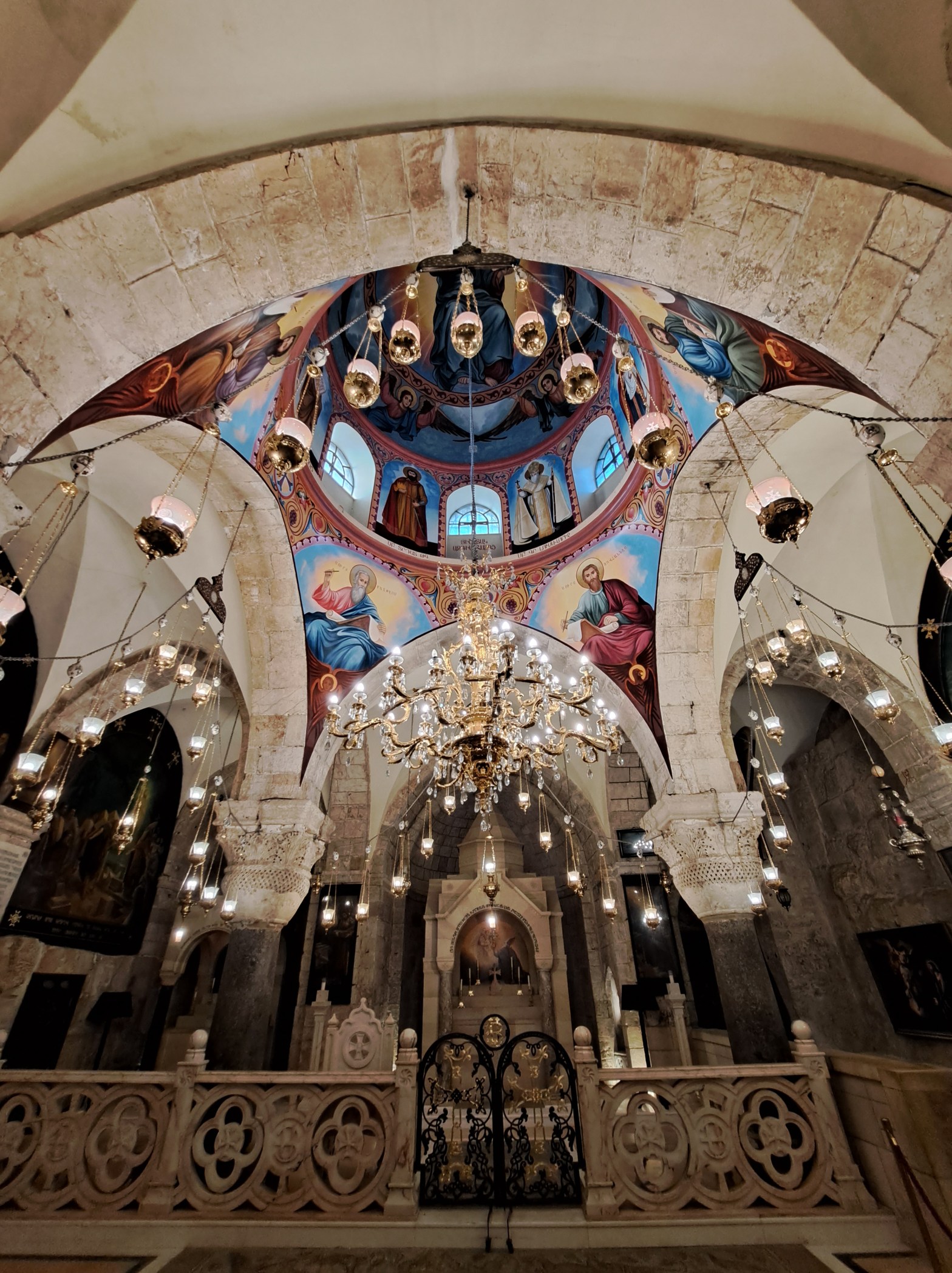
The taxi driver who took me to Amman turned out to be a guide as well. What began as an evacuation became two days of unhurried exploration — Jewish and Christian sites across the Jordanian countryside, the Dead Sea, the hilltop where Moses saw the promised land before he died.

I was still carrying the adrenaline from the night before. Not fear — the danger had passed. Something more like heightened aliveness. Colors looked more saturated. Sounds were sharper. The landscape felt more present than landscape usually does.

I have heard soldiers describe this after operations. The world becomes briefly more real than normal. You notice things you would otherwise walk past.

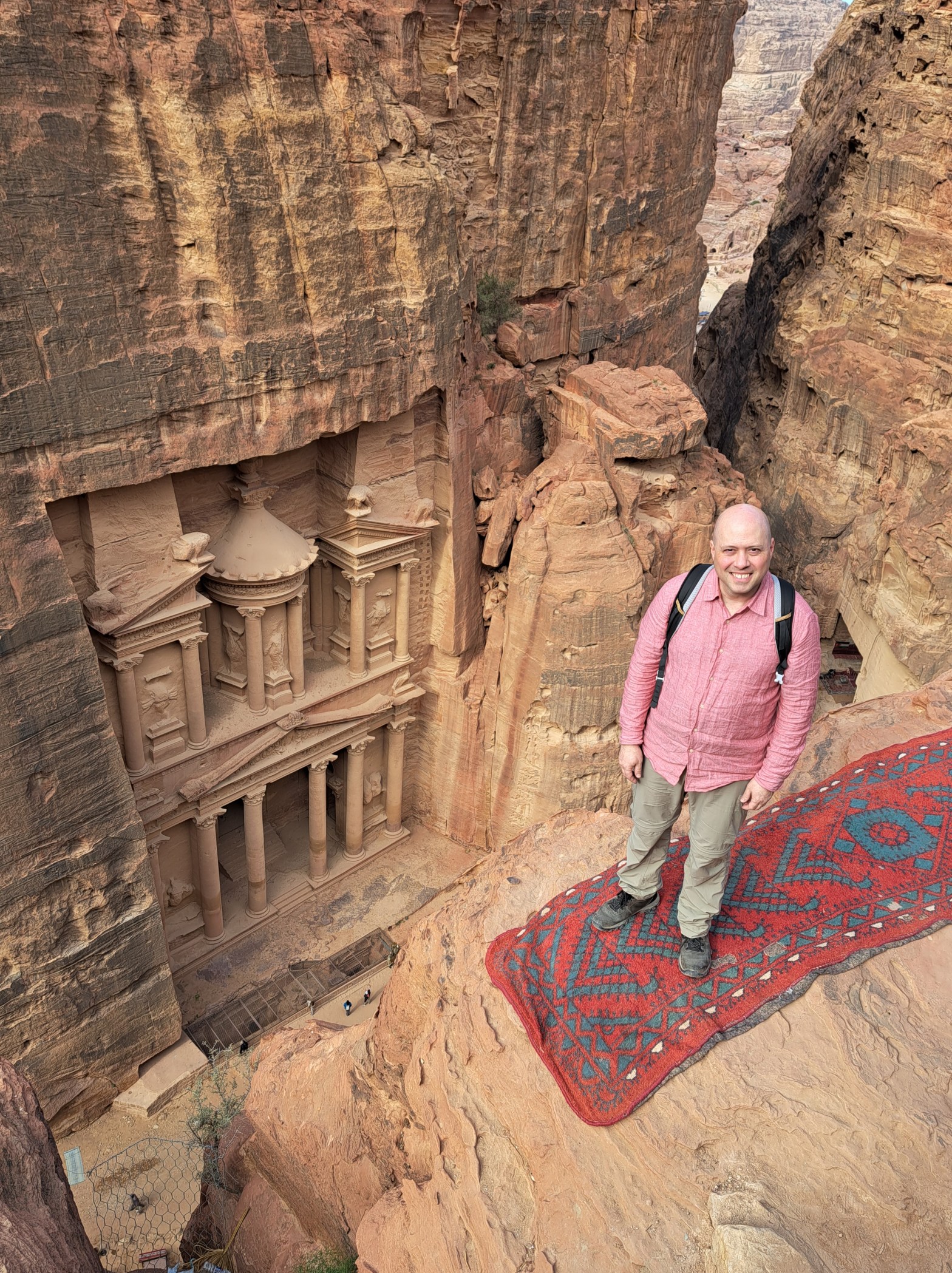
A couple of days earlier in Petra, before the cat and before the escape, I had sat in a Bedouin family’s tent and shared tea with them. My guide that day was Bedouin himself and had told me about his people — their nomadic life, their hospitality, the way they hold their possessions lightly enough to carry everything they own from place to place. I had read about Bedouin culture many times. But sitting in that tent, with a few simple structures and a handful of handmade trinkets arranged around a family who seemed entirely unburdened by what they didn’t have, the abstraction became a person. Several persons.

I thought about how much I carry. How much most leaders carry. How much of it is essential and how much is weight we’ve accumulated without noticing.

The nomads seemed unburdened in a way I found quietly extraordinary. I was still thinking about it two days later, racing toward Amman in a caravan of taxis, watching the Jordanian desert pass at speed. What decision have you made under incomplete information that you still think was right — and how did you know it was time to move?

The Cat in Petra

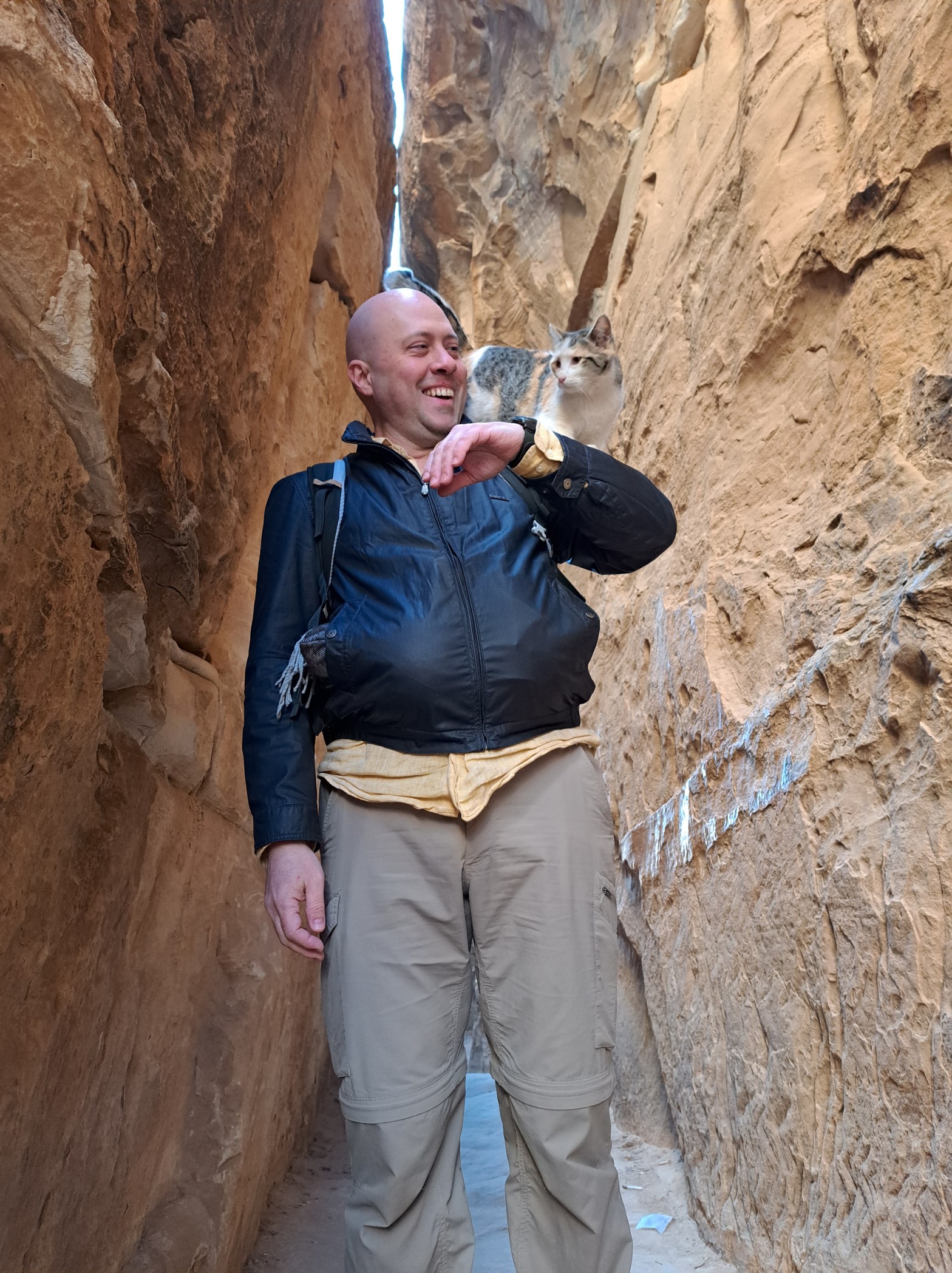
I did not plan to spend twenty minutes in a sandstone crevasse with a feral cat on my head.

The last day in Petra, I took a detour — a longer hiking path that approached the ruins from a different angle, less traveled, quieter than the main tourist routes. The kind of path you take when you’ve already seen the Treasury and the cliff dwellings and the famous sites, and you want to see what Petra looks like when nobody is selling you anything.

I stopped at a small outdoor snack stand cut into the rock — one of those tented, improvised setups that appear wherever tourists eventually wander. I sat. I rested. And a cat appeared.

Petra has cats the way Rome has pigeons. Feral, independent, operating entirely on their own terms. This one circled my feet for a while, the way cats do when they’re deciding something. I may have shared some food. I don’t fully remember. What I remember is that when I stood up to continue hiking, he climbed up my leg to my shoulder and then to my head.

I decided not to move.

He climbed around my shoulders and head for twenty minutes in that narrow sandstone passage — the rock walls close on both sides, the air cooler in the shade, the sounds of the main ruins distant and irrelevant. I stayed longer than I needed to. I wasn’t going anywhere while this was happening.

Then he left. Without looking back. As cats do.

I smiled for the rest of the day — through hours of hiking, past temples and tombs and the long walk back past the Treasury into town. The smile just stayed.

I thought afterward that it felt like a small peck on the cheek from God. Unexpected, unearned, unbothered by my schedule or my itinerary or what I had planned to accomplish that afternoon. Just a brief, warm, ridiculous gift in a sandstone crack in the middle of the Jordanian desert.

Grace doesn’t always announce itself. Sometimes it climbs up your leg and sits on your head for twenty minutes and then walks away without looking back.

And that’s enough.

When did you last receive something you didn’t plan for and couldn’t have arranged — and did you let yourself stay in it long enough to feel it?

Yes, And

Before I learned to lead well, I believed leadership was a competition.

Not consciously. Not as a stated philosophy. But embedded in how I made decisions as a government program manager: resources were finite, budgets were zero-sum, and for my program to succeed, another program somewhere had to absorb the loss. Us versus them was not strategy. It was assumption.

Then I became Deputy Chief Engineer for GPS.

GPS had 2.5 billion customers at the time — navigation systems, financial networks, military operations, civilian aviation, smartphones in pockets on every continent. Decisions made in our program affected all of them, often simultaneously, often in ways that conflicted. We made decisions like that a dozen times a day.

The us-versus-them framework collapsed immediately. There was no them. There were only stakeholders with legitimate competing needs, and a responsibility to find the path that satisfied as many of them as possible without betraying the mission.

What I found already waiting for me at GPS — built into the culture before I arrived — was something I came to think of as Yes, And. Not yes-but, which is polite refusal. Not either-or, which is false constraint. Yes, And: the creative insistence that a way exists to honor multiple legitimate needs simultaneously, even when it isn’t obvious, even when it requires more work than simply choosing a winner.

I fostered that culture for three years. Then I passed it on and carried the lesson with me.

———

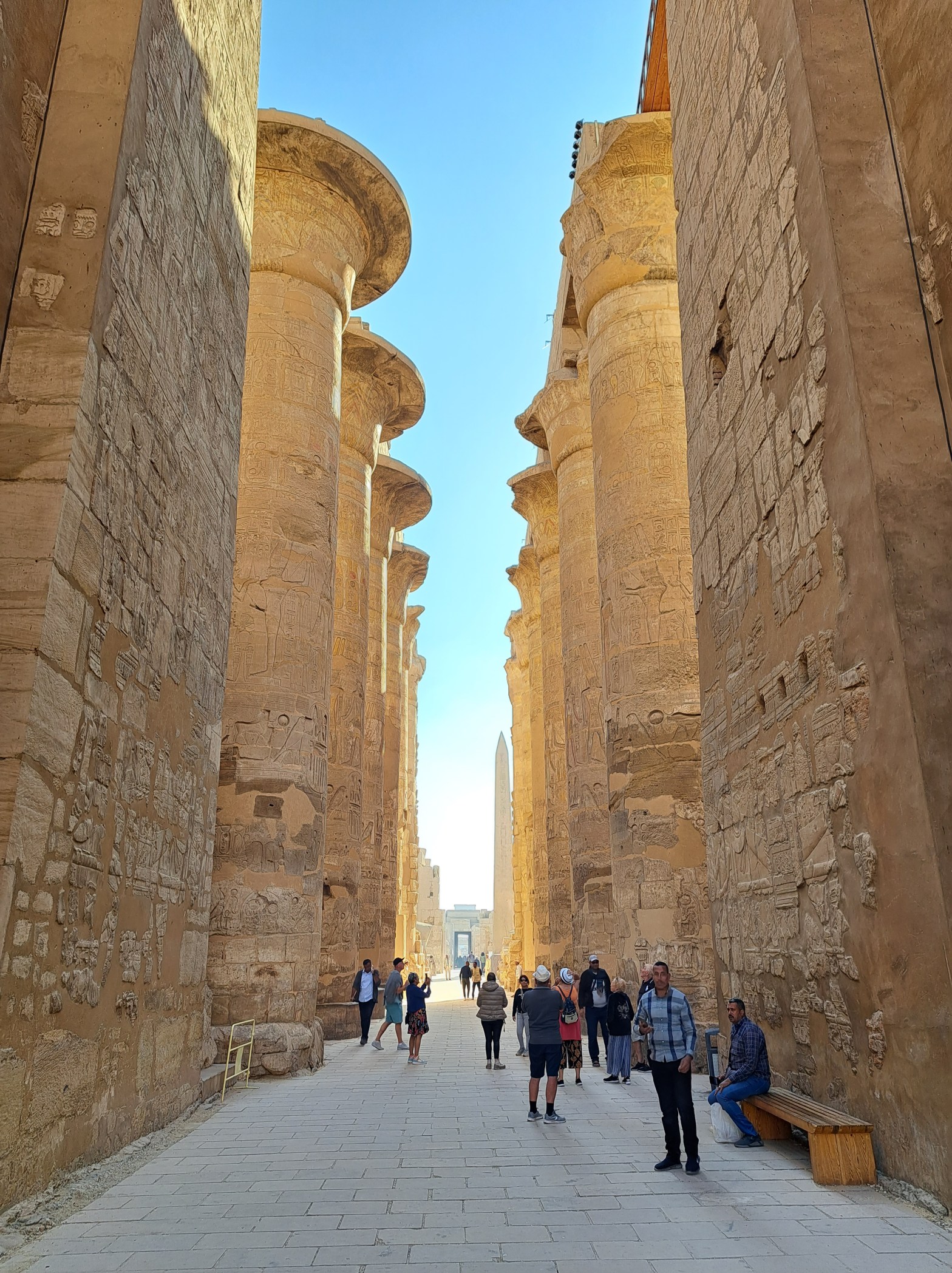
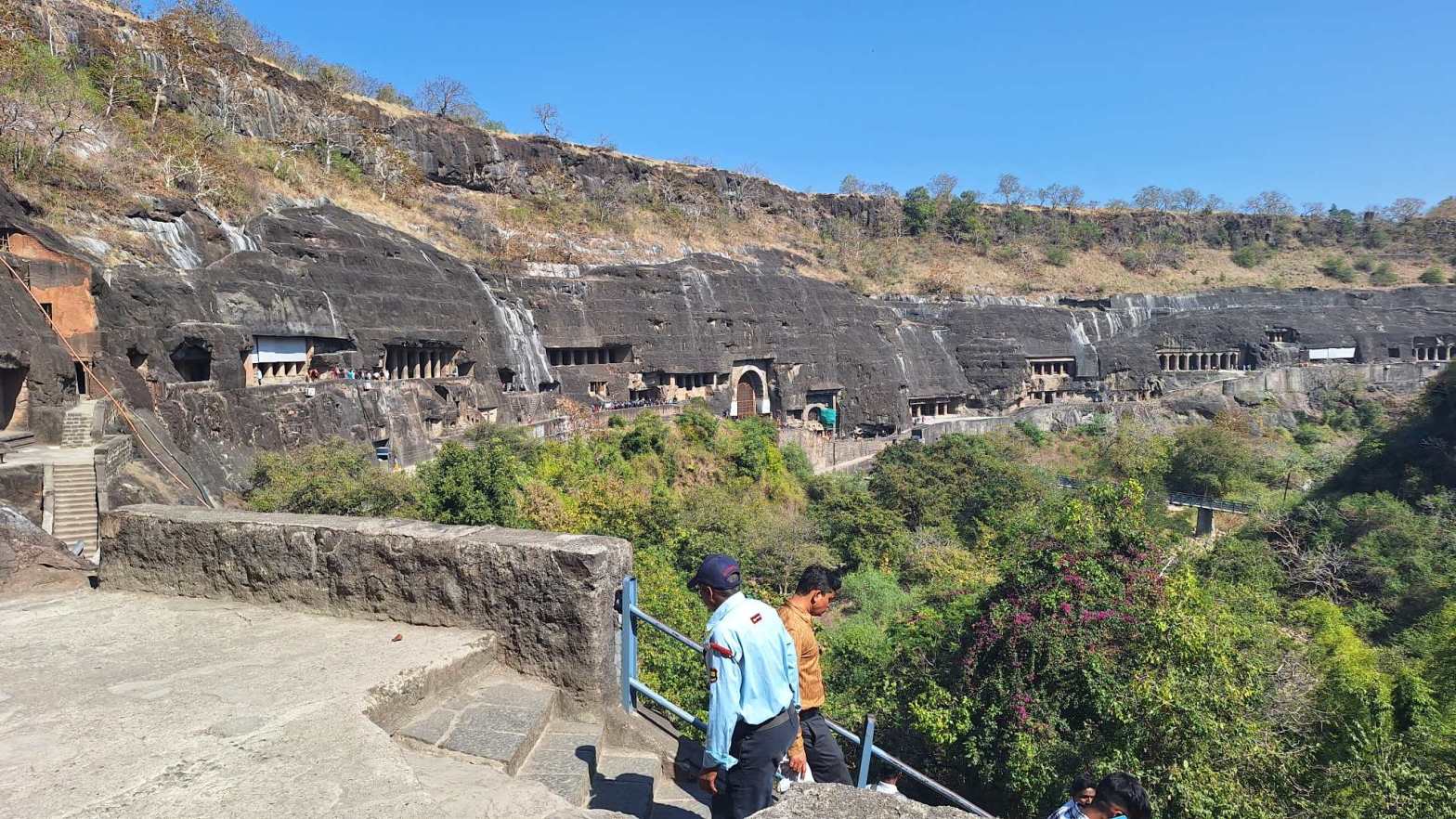
I did not know, when I walked into Karnak or climbed toward the cliff temples at Hampi or stood inside the carved halls of Ajanta, that I was still practicing the same discipline.

But I was.

What the columns at Karnak taught me — those stones that absorbed three thousand years of conquest, renaming, conversion, burial, and excavation and are still standing — is that endurance is not the same as dominance. Every king who scratched his predecessor’s name from the walls believed he was winning. The walls held all their names equally, and outlasted all of them equally. Power competed. Stone endured.

What the craftsmen at Ajanta taught me — generations of workers who carved monasteries from solid rock and died before the work was finished — is that the most significant contributions are often made by people who never see the outcome. They didn’t build for recognition. They built because the work was worth doing. Their irrelevance to history is precisely what made their work historical.

What the first week in India taught me — the gout, the over-planned itinerary, the joy I couldn’t access because I was too busy managing the experience — is that control and presence are often in direct competition. The tighter the grip, the less you actually receive.

Three different lessons. The same underlying discipline: allow the revelation to occur. Notice it. Accept what it is teaching you rather than defending against it.

———

That is harder than it sounds for people like me. Trained in systems thinking, credentialed in program management, experienced in high-stakes decision environments where the cost of being wrong is measured in billions and sometimes lives. We are not naturally permeable. We are trained to be defended, structured, decisive.

But GPS taught me that the most creative and effective leadership I ever practiced came not from imposing a framework but from asking a better question. Not who wins but what does this situation actually need? Not how do I control this but what is this trying to teach me?

The columns at Karnak were not designed to teach me anything. They were designed to glorify kings who are dust. But they taught me something the kings never intended: that what endures is rarely what was built for permanence, and what matters is rarely what was built to impress.

The things I have built in my career — programs, teams, systems — are satellites. Precise, capable, fragile, finite. I am proud of them.

But I am building something now that I want to be more like a column. Not large. Not imposing. Grounded in something that does not move — biblical truth, mission clarity, faithful stewardship — and patient enough to still be standing when the sand rises and falls again.

The lesson from GPS. The lesson from Hampi. The lesson from Ajanta and Karnak.

Yes. And.

What would you build differently if you measured it against columns instead of quarters?

Two Kinds of Small

I want to tell you about the camel first.

My guide arranged it as a tourist experience near the pyramids at Giza — the silly photographs, the desert backdrop, the whole production. What he did not arrange was accompaniment. The camel handler led me out into the open desert, away from the crowds, away from my guide, away from anyone I knew, and then stopped.

He wanted more money to take me back.

I knew intellectually that this was a standard tourist shake-down. I knew he almost certainly would have taken me back regardless. I knew none of this was genuinely dangerous.

I was still afraid. I didn’t know how to ride a camel. I had no idea which direction led back. There was no one to help me if this went sideways. I paid the $20, felt the particular humiliation of knowing you’ve been played and having no good alternative, and did not separate myself from my guides like that again for the rest of the trip.

A retired Lieutenant Colonel. A program manager of billion-dollar systems. Stranded in the Egyptian desert by a camel and a $20 shakedown.

There is a specific kind of smallness that comes from being out of your depth in someone else’s environment. I had felt competent all morning. The desert removed that in about four minutes.

———

But that was a different kind of small than what came later at Karnak.

When I walked through the entrance to the main temple complex at Karnak in Luxor, I thought of a scene from a film I watched as a child — Atreyu entering the Valley of the Southern Oracle in The Neverending Story. A small figure moving into a chasm so vast and ancient that his size simply stops mattering. The avenue of sphinxes lining the approach. The walls rising on both sides to a height that made the open sky above feel like a narrow crack of light.

I was a speck. Not a small person — a speck. The distinction matters. A small person still registers. A speck does not.

One stone dropping from those walls would have ended me without ceremony.

I walked on sand. The same sand, more or less, that had been accumulating here for millennia — rising century by century until windows became doors, until doors became buried, until the entire complex disappeared beneath the surface and was simply gone from human view for a thousand years. The sand did not destroy the columns. It absorbed them. And when excavation began a century ago and the sand was finally removed, the columns were still there. Exactly where they had always been.

Still standing in the same coordinates where priests had performed rituals, where kings had scratched out each other’s names, where Christians had converted pharaonic temples into churches, where Muslims had converted those churches into mosques — each civilization rewriting the walls, none of them moving the stones.

I thought about my own work. Satellites I helped design and deploy. Rockets. Systems that cost billions and took decades. Precise, capable, extraordinary by any modern measure.

And fragile. Profoundly fragile. The smallest deviation — a temperature variance, a micrometeorite, a software error — renders them inoperable. We built redundancies upon redundancies because we knew how easily they could fail.

These columns were not designed with redundancies. They were cut from stone and stood up and left there. And they are still standing after three thousand years of everything the world could do to them.

———

There are two kinds of smallness I have now felt in my life.

The first is the smallness of being out of your depth — competence stripped away by an unfamiliar environment, no guide in sight, a camel handler waiting for his $20. That smallness is uncomfortable and instructive. It tells you where your actual edges are.

The second is the smallness of standing inside something so far beyond your scale that your accomplishments simply stop being the relevant unit of measurement. That smallness is not uncomfortable. It is clarifying.

At Karnak I left my footprints in the sand. Small ones. The wind will have erased them within days.

The columns did not notice. But I did.

What has made you feel genuinely small recently — and what did that smallness teach you?

Time as a Flip Book

I once had a serious conversation with colleagues about whether time actually exists.

Not as a thought experiment. As a professional question. GPS satellites orbit at altitudes where Einstein’s relativity is not theoretical — it is an engineering problem. Time moves measurably differently up there than it does down here. If you don’t account for it, your positioning errors compound at roughly 11 kilometers per day. We built corrections into the system because we had to.

So what exactly is time? A physical reality? A convenient framework for tracking cause and effect? A human invention that breaks down at sufficient scale or velocity? I have sat in rooms with serious people and asked that question without a satisfying answer.

I did not expect Cairo to answer it either. But it came closer than the conference rooms did.

———

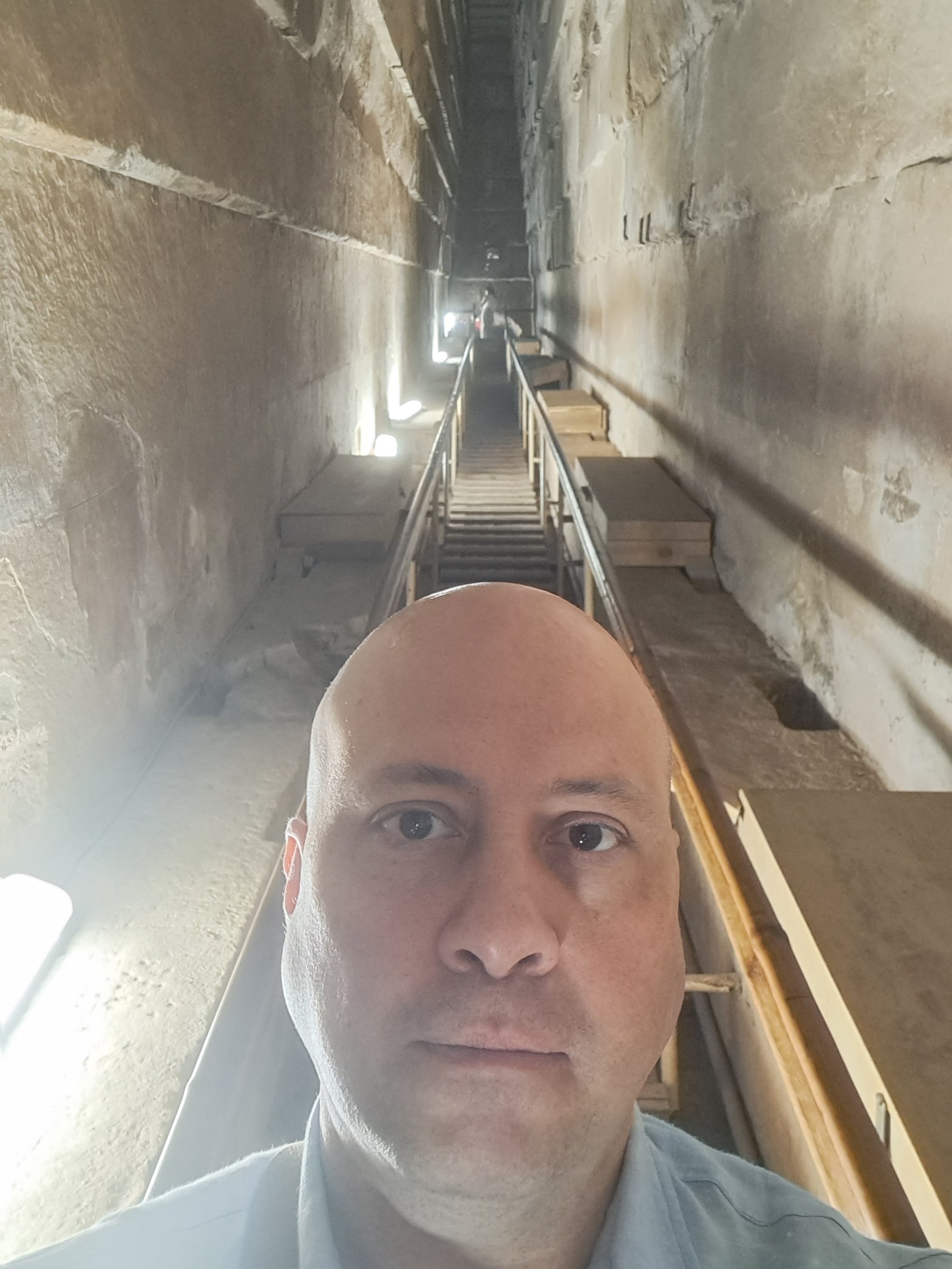
Standing inside the King’s Chamber of the Great Pyramid of Giza, I felt something I don’t have precise language for. The chamber is small, quieter than you expect, cut from granite blocks fitted together with a precision that still confounds engineers. I stood there and felt the past moving through the present like a current through water.

Not metaphorically. Sensorially.

I started thinking of it as a flip book. You know the kind — each page is a single still image, and when you run your thumb across them the pictures animate. Standing in that chamber, I felt like I could run my thumb across time itself. The same coordinates, different centuries. The king being carried to his burial chamber. Priests performing rituals by torchlight. Tourists in 2022 taking photographs with their phones.

All of it at the same address.

———

Later that day I visited a place in Cairo where the Holy Family lived — Mary, Joseph, and Jesus — during their flight from Herod. A small room. A piece of floor. A stone curb worn smooth.

I have felt God’s spiritual presence many times. I am Pentecostal; that is not unfamiliar territory. But I had never before stood in a specific physical location where Jesus actually was. Not symbolically. Corporally. The same floor. The same air, more or less. A boy who scraped his knee here and probably cried, and his mother shushed him and held him on that stone curb.

I stood there for a long time.

The flip book again. But this time I wasn’t running my thumb across history. I was standing in the middle of it, and it was running through me.

———

I am a physicist by training. I have spent decades working on systems that only function because we take seriously the idea that time is not fixed, not universal, not what it appears to be from the ground.

I still don’t know if time exists in any ultimate sense.

But I know that room in Cairo exists. And I know something happened there that I am still thinking about two years later.

Have you ever stood somewhere and felt the past move through you — not as a concept, but as a physical sensation?

Surprise me

By the time I reached Rajasthan, I had stopped trying to know what was coming next.

I gave my tour guide three criteria: full logistics handled, show me the regional history, and surprise me. That last part wasn’t in the brief — it was just what happened when I finally ran out of things to control.

I didn’t research the stops in advance. I didn’t cross-reference the sites against travel rankings or optimize the sequence. I didn’t know enough about Rajasthan to even begin making those choices well — and for the first time on the trip, I was honest enough with myself to admit it.

So I floated. Through sites and sounds and tastes I hadn’t anticipated, couldn’t have planned, and wouldn’t have chosen because I wouldn’t have known to choose them.

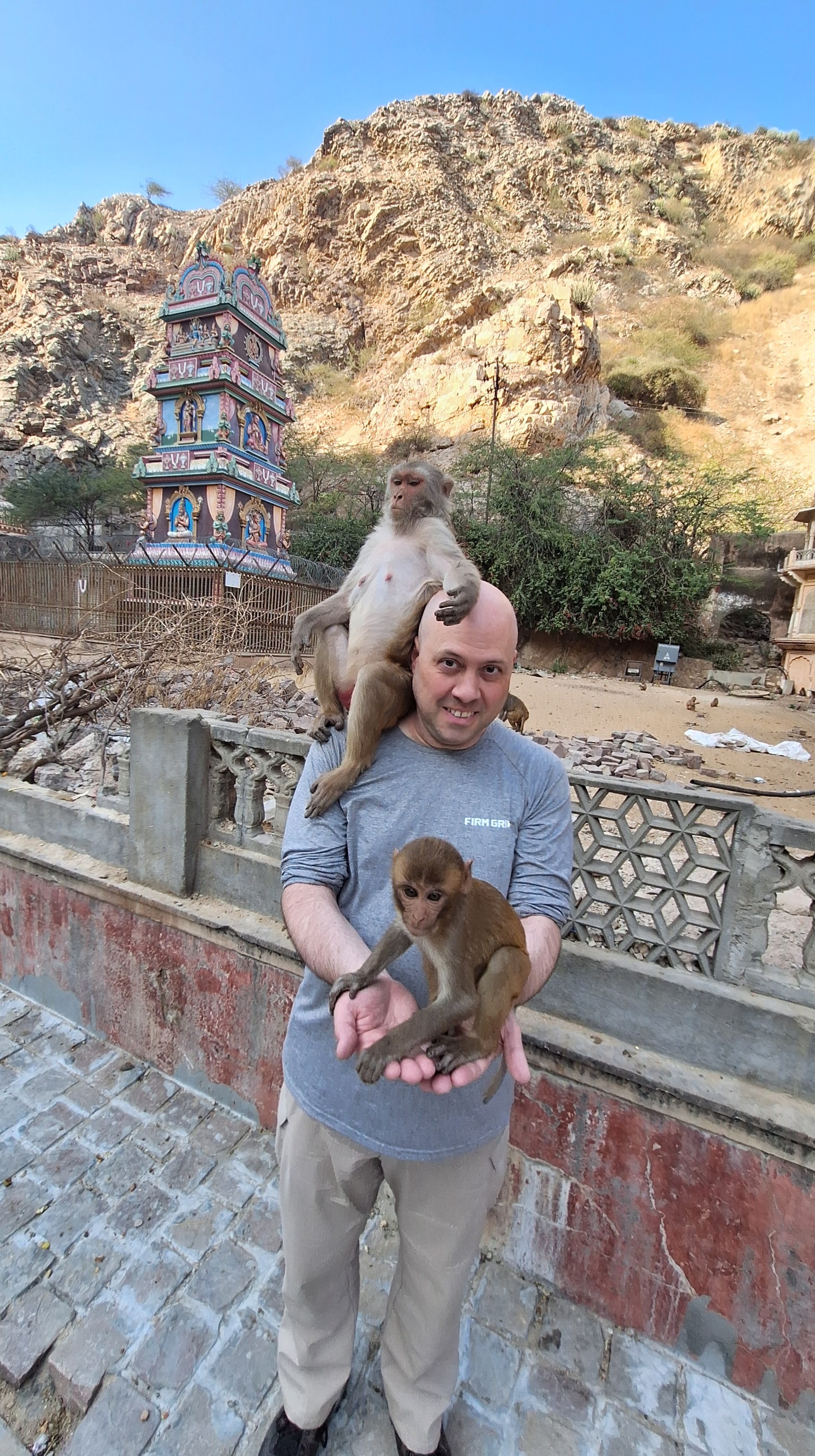
In Jaipur, my guide took me to Galtaji — the monkey temple. A Hindu pilgrimage site built into a narrow mountain pass, surrounded by jungle. He put monkeys on me for photographs. Ridiculous, grinning, thoroughly undignified photographs.

I walked through the complex with no agenda, no objective, no schedule pressing at the edges of the experience. The monkeys screeched in the canopy. Birds called across the hillside. The jungle sounds moved around me and through me.

It wasn’t a Hindu moment or a Buddhist one. It was something quieter and more personal. I felt God’s presence moving through his creation — the noise, the animals, the ancient stones, the warm air — into and around me. Not as a theological proposition. As an experience. I was simply there to receive it.

That doesn’t happen when you’re managing the itinerary.

———

I started this trip as I start most complex things: with a plan, a structure, and the confidence that my systems would hold. They didn’t — not because India broke them, but because the best things India had to offer existed entirely outside the boundaries of what I could have planned for.

The lesson wasn’t don’t plan. I’ll always be a planner. The lesson was simpler and harder: know which things yield to a plan and which things only arrive when you stop imposing one.

I came home from six weeks in India and Nepal with more than photographs and a cleared-up case of gout. I came home knowing the difference between managing an experience and having one — and knowing, with some precision, which version of myself I want to lead from.

What are you over-managing right now that might reveal itself if you loosened your grip?

What Ajanta Asked of Me

I felt irrelevant at Ajanta. It was the best thing that happened to me on the trip.

In Egypt, standing at the base of the pyramids or inside the rebuilt temples at Luxor, I felt small. That’s the word most people use. Small, humbled, dwarfed by scale.

Ajanta was different. The caves aren’t enormous in the way the pyramids are enormous. They are carved inward — monasteries, temples, columns, statues, decorated halls, tables, chairs — cut from solid basalt hillside by generations of craftsmen who began at the ceiling and worked downward, chip by chip, removing the mountain to reveal what was inside it.

The largest took centuries to complete. Multiple generations of workers contributed to structures they would never see finished. They didn’t build something. They revealed something, slowly, faithfully, across lifetimes.

Standing inside one of those halls, I felt something I didn’t expect: irrelevance. Not smallness — irrelevance. My plans, my program management instincts, my carefully constructed itinerary, my career, my anxiety about whether I was doing this trip correctly — none of it registered against what these walls represented.

In Egypt I felt like a small version of myself. At Ajanta I felt like a vapor. A true vapor. Here and gone.

And that was wonderful.

Because here is what I realized: I had spent my first week in India trying to be indispensable to my own trip. Controlling the details. Managing the outcomes. Making myself necessary to every decision. And the weight of that had stolen the very thing I’d traveled 8,000 miles to find.

Ajanta didn’t ask anything of me. It didn’t need me to manage it, improve it, or validate it. It had been there for 1,500 years and would be there long after every photograph I took had faded. All it asked was that I show up and receive it.

That’s when I stopped fighting the trip. And started taking it. What would you be free to receive if you stopped trying to manage it?

I Chose to Climb

I chose to climb.

The ruins at Hampi stretch across a landscape almost the size of ancient Rome — boulder-strewn, vast, and only partially reachable by car. To see the cliff-side temples, to get close enough to read the decorative carvings on ancient stone walls, to stand where a 15th-century empire once stood and look out across that landscape — you have to walk.

I had gout in my left foot. Every step on uneven ground cost me something real.

I climbed anyway. Because you don’t fly to South India and stay in the car.

But here’s what I remember most about those first days: I wasn’t fully present for any of it. Not because of the pain — I could manage the pain. I was absent because I was simultaneously managing everything else. The next day’s logistics. The transportation I’d arranged. Whether the accommodations I’d booked were actually what I’d been told they were. Whether my planning — meticulous, systematic, the kind I’d applied to billion-dollar programs — was going to hold up in a country I didn’t actually understand yet.

It didn’t. Not really. India doesn’t yield to that kind of control. I was carrying the weight of a planning apparatus I wasn’t experienced enough to run in this context, on top of an aching foot, in 90-degree heat, surrounded by one of the most extraordinary landscapes I’d ever seen.

I had confused controlling the experience with having it.

The temples were magnificent. I know that intellectually. I have the photographs.

But I was somewhere else.

Have you ever worked so hard to manage something that you couldn’t actually be present for it?

Experiencing Culture Shock in France

Culture shock is often felt sharply at the borders between countries, but sometimes it doesn’t hit fully until you’ve been in a place for a long time.

Henri Cartier-Bresson

Nobody expects the Spanish Inquisition! (or stages of culture shock, either)

Monty Python

I studied cross-cultural communications before moving to France. I read multiple books on integrating into a new culture. I was told what to expect to feel over the first year or two of living in a new country. Even with all that preparation, I was not really prepared to recognize the feelings and stages of culture shock.

Cultural Anthropology, Anthropological points of view by Paul Hiebert (Howard Culbertson, 5901 NW 81st, Oklahoma City, OK 73132 | Phone: 405-740-4149)

Let me regale what I experienced over the first ten months in France and how culture shock affected me unawares. And what I did to address the culture shock and continued to enjoy my time in Paris.

October 2021 (Month 1): A new adventure! I was excited and optimistic about my new life in Paris. Even though I didn’t speak the language, I fumbled through looking for an apartment and setting up a cell phone. I asked people if they spoke English to help me with these steps. Thankfully a lot of French speak English and were gracious enough to work with me. Paris celebrates Halloween, which helped me to feel a little at home. I started taking swing dance classes, attending dances, and attending church services to build a normal rhythm in my life.

November 2021 (Month 2): I wish I spoke French! This month I moved into my new apartment in Paris and really wished I spoke French. Setting up electricity, gas, internet, and a bank account would have gone a lot smoother if I spoke French. During this month, I asked my French friends to translate for me when I needed to speak to someone who did not speak English. The French do not celebrate American Thanksgiving which was my first feeling of homesickness. I found a British sandwich shop that served a great turkey sandwich to observe Thanksgiving in the way I could having just arrived in Paris.

December 2021 (Month 3): No gas in a cold month and desire to spend holidays with family! The homesickness was starting to feel strong. I also ran into the problem of having my gas cut off since I did not set-up the service correctly in November. I used Google Translate to get through the websites. Again I worked with my French friends to translate telephone conversations when dealing with the utility companies. In addition, I spent Christmas with my family in Florida, USA, to reset the homesickness barometer. This is the month I started my French lessons to address needing to speak the language.

January 2022 (Month 4): A new normal schedule! I started feeling the need for a regular pace of activity to fill my week. This month I developed my Paris schedule with 20 hours of French classes each week, weekly swing dance lessons/dances, and church services. The regular schedule helped me develop new friends in these three areas who helped me tremendously to adjust to life in Paris.

February 2022 (Month 5): Will I ever learn French?! This month I was beginning to feel frustrated with how hard it was going to be for me to learn French. I had been studying for three months, and I was not feeling like I was progressing very well. I felt disappointed in myself, partially due to my age, and wondered if I were ever going to be fluent in this new language. In response, I talked to my French instructor, my fellow students, and my French friends. They all assured me that I was progressing as expected and that it took a long time (a year-and-a-half to two years) to become fluent in a new language.

March 2022 (Month 6): I need to hear English! This month I started feeling irritable and short tempered. It took me a week or two to figure out what it was. I missed hearing English around me in the background. Once I realized what the issue was, I took a week trip to London (by train) to immerse myself in English. I skipped this month of French lessons to give myself a break. Between these two actions, I addressed this stage of culture shock and moved passed it successfully.

April 2022 (Month 7): I need American BBQ! This month I felt the need for some good old American food. The specific craving was for American BBQ. Thankfully, there are a number of these restaurants throughout Paris. After trying all five or six of them, I settled on one or two to visit once a week to fill this craving for American food. My favorites are Rosies Smokehouse BBQ and Freddy’s BBQ. Although, there are a number throughout Paris and all of them were pretty good. One big item missing from Paris is Banana Pudding. Apparently the French do not like this particular dessert. Those places that offered it decided to discontinue the dessert since the demand was too low.

May 2022 (Month 8): Who am I? This month I started feeling a general listlessness – a feeling of not really belonging anywhere. Do I belong in Paris now, or do I still belong in the USA? I felt like a ship drifting in the sea with no rudder or engine. In the past, I wouldn’t discuss these kinds of feelings with others. But, having learned from hard lessons of the past, this time I did. I expressed my existential conundrum with my friends and family. Once I expressed what I was feeling, I felt much lighter. Coming to terms with living with little responsibility or possessions frees me to enjoy life as it comes. My prior life of feeling worth or productivity through my jobs or activities was no longer applicable.

June 2022 (Month 9): Why am I here? This month I started feeling uncertain of what I am doing in France for the long term. I was feeling that my motivation lacked compared to my prior life in the USA. I no longer had the strong drive to accomplish a long list of tasks and goals. Having discussed this too with my friends and family, I came to terms with my level of motivation and how it was appropriate for what I was doing in Paris: learning French, dancing, attending church, and enjoying the city. I was not suffering from a total lack of motivation, just an amount commensurate with my level of responsibilities in Paris (or lack there of).

July 2022 (Month 10): Now what? A sabbatical, really? The feelings of listlessness and drifting aimlessly continue. I wonder what am I going through now and why I cannot shake these feelings. I spend a lot of time in prayer, and in discussions with family and friends. I even take a week to be back in the USA to take care of some pressing issues back there. After all this introspection and analysis, I realize that this time in Paris is much more like a sabbatical than a new career. Over the years I had heard of many of my friends take sabbaticals, especially professors and missionaries. I realized that I had not taken a break of more than a few weeks in over 30 years. No wonder I needed to decompress and alleviate all these decades of pent up stress. Realizing this lifted a tremendous burden. Knowing that I am experiencing a much-needed sabbatical frees me to experience the emotions in that light.

August 2022 (Month 11): Coming to terms with the next steps! Now it has been over ten months that I have lived in Paris. This has been worth every day through the combination of new experiences, new friends, and whatever frustrations have come my way. I am indebted to my friends, family, and God for being with me through these months. I have grown a lot, changed a lot, and mellowed out a lot, too. As my first year comes to a close in less than two months, I am examining the next steps. Regardless of what happens or where I go, I wouldn’t trade this year in Paris for anything.

Until we meet in Paris…

Exchanging my US Driver’s License for a French One

A few months back, I was able to exchange my US driver’s license for a French one (permis de conduire). The process was fairly straightforward but did take a few months to finish. The most important things to remember are to exchange it within the first year of living in France and that you will not be getting your US license back. It’s a formal exchange for France for your US license for a French one. I do not know yet if the prior issuing location even knows. So, if you still need one for traveling in your home country, I would check with your home country or state Department of Motor Vehicles.

REMEMBER: COMPLETE THIS PROCESS WITHIN THE FIRST YEAR OF YOUR VISA OTHERWISE YOU WILL NEED TO TAKE THE FRENCH DRIVER’S COURSE IN FRENCH TO OBTAIN YOUR FRENCH DRIVER’S LICENSE. AFTER THE FIRST YEAR, YOU WILL NOT BE ABLE TO USE YOUR FOREIGN DRIVER’S LICENSE TO DRIVE IN FRANCE.

To start the process, make sure you have validated your Visa with OFII (https://administration-etrangers-en-france.interieur.gouv.fr/).

Check to make sure you can exchange your current driver’s license for a French one. There is a list of countries and US states that France recognizes. Here is a recent list (https://www.diplomatie.gouv.fr/IMG/pdf/—_liste_permis_de_conduire_valables_a_l_echange_09.12.2021—_cle8735a7.pdf), but be sure to check the latest list before submitting your application.

Apply to the Agence nationale des titres sécurisés website (https://permisdeconduire.ants.gouv.fr/).

You will need:

  • Your valid drivers license (valid before your Visa effective date)
  • A driver’s record from your home country/state showing you are in good standing with your DMV
  • A certified translation of your driver’s license into French
  • A certified translation of your driver’s record into French
  • Copy of your passport (full page including signature) with the following on the scanned copy with your signature “J’atteste sur l’honneur que cette copie est conforme à l’original. Fait le XX XXX XX à Paris.”
  • Copy of your Visa or titre de sejour (full page) with the following on the scanned copy with your signature “J’atteste sur l’honneur que cette copie est conforme à l’original. Fait le XX XXX XX à Paris.”

To apply for the driver’s license exchange…

1. Go to the ANTS website

2. Click on “Echanger un permis étranger ou obtenu dans une COM pour un permis français”

3. Click on “Commencer votre demarche en ligne” to start the process. Be sure to read all instructions to ensure you have the latest changes in requirements or instructions.

Once you’re approved, you’ll receive instructions on where to send the driver’s license and originals of the translations/driver’s record. Be sure to make copies of everything since France will not return anything to you.

While your new driver’s license is being produced, be sure to keep the attestation as well as copies of your prior driver’s license until your new French driver’s license arrives. The French Driver’s License is valid to drive in most of the world as well as throughout the European Union. Be sure to check wherever you are traveling outside the EU to understand the driving requirements of those countries.

REMEMBER: COMPLETE THIS PROCESS WITHIN THE FIRST YEAR OF YOUR VISA OTHERWISE YOU WILL NEED TO TAKE THE FRENCH DRIVER’S COURSE IN FRENCH TO OBTAIN YOUR FRENCH DRIVER’S LICENSE. AFTER THE FIRST YEAR, YOU WILL NOT BE ABLE TO USE YOUR FOREIGN DRIVER’S LICENSE TO DRIVE IN FRANCE.

I hope this was clear and useful for you.

Until we meet in France…