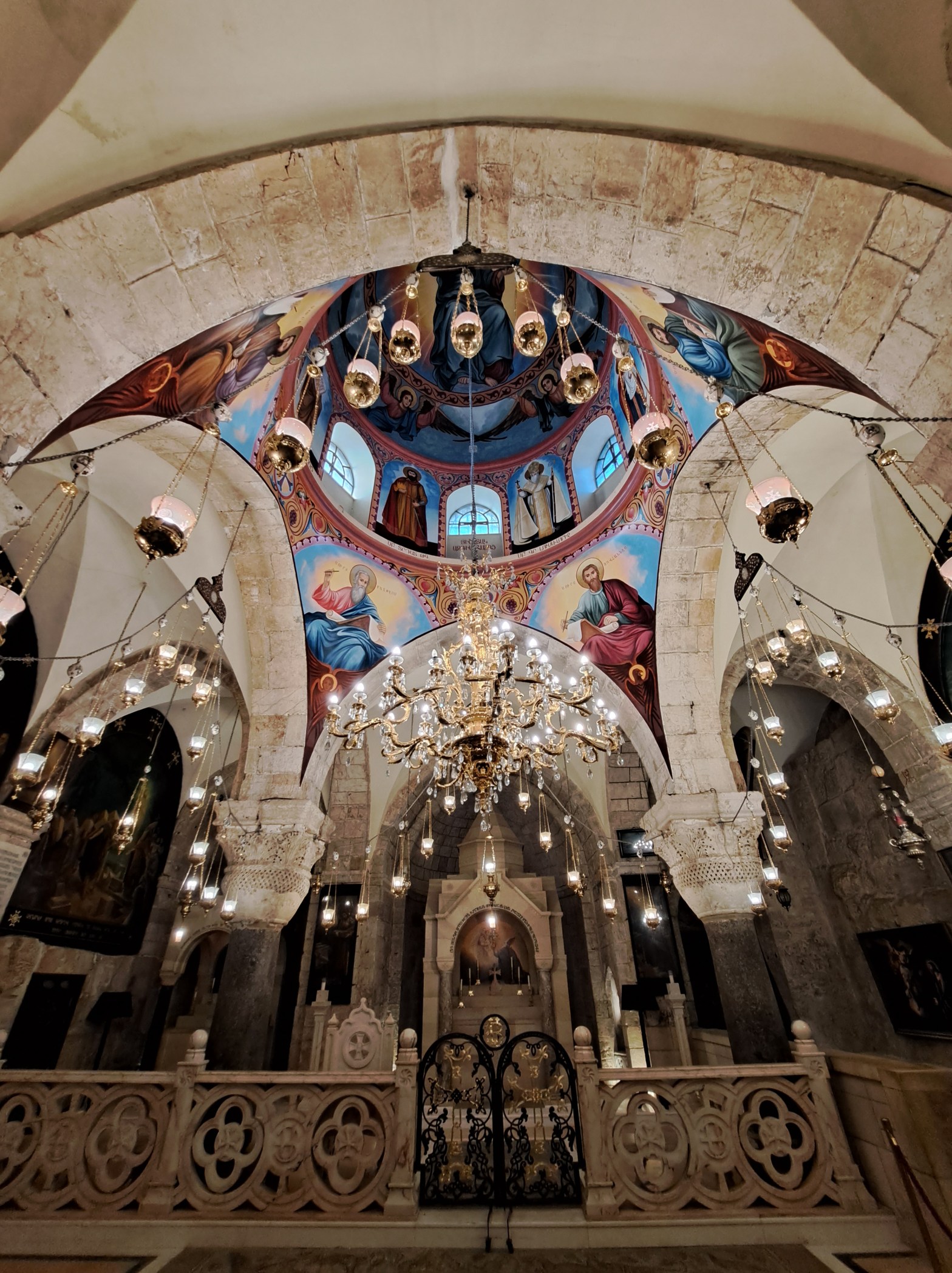
The Church of the Holy Sepulchre is not one church.
It is many churches sharing one building — Greek Orthodox, Roman Catholic, Armenian Apostolic, Coptic, Ethiopian, Syriac — each branch of Christianity with its own section radiating outward from the center, which is the place where Christians believe Jesus was crucified, buried, and rose. You move between cathedral styles by passing through thin walls. Byzantine gives way to Romanesque gives way to something older and darker and more incense-thick. The architecture of two thousand years of Christian division contained in a single complex, navigated like a maze.
I found it impressive and disorienting in equal measure. The building is a physical map of everything Christianity has agreed upon and everything it has fought over, compressed into a space where the fighting and the agreeing share the same stone floor.
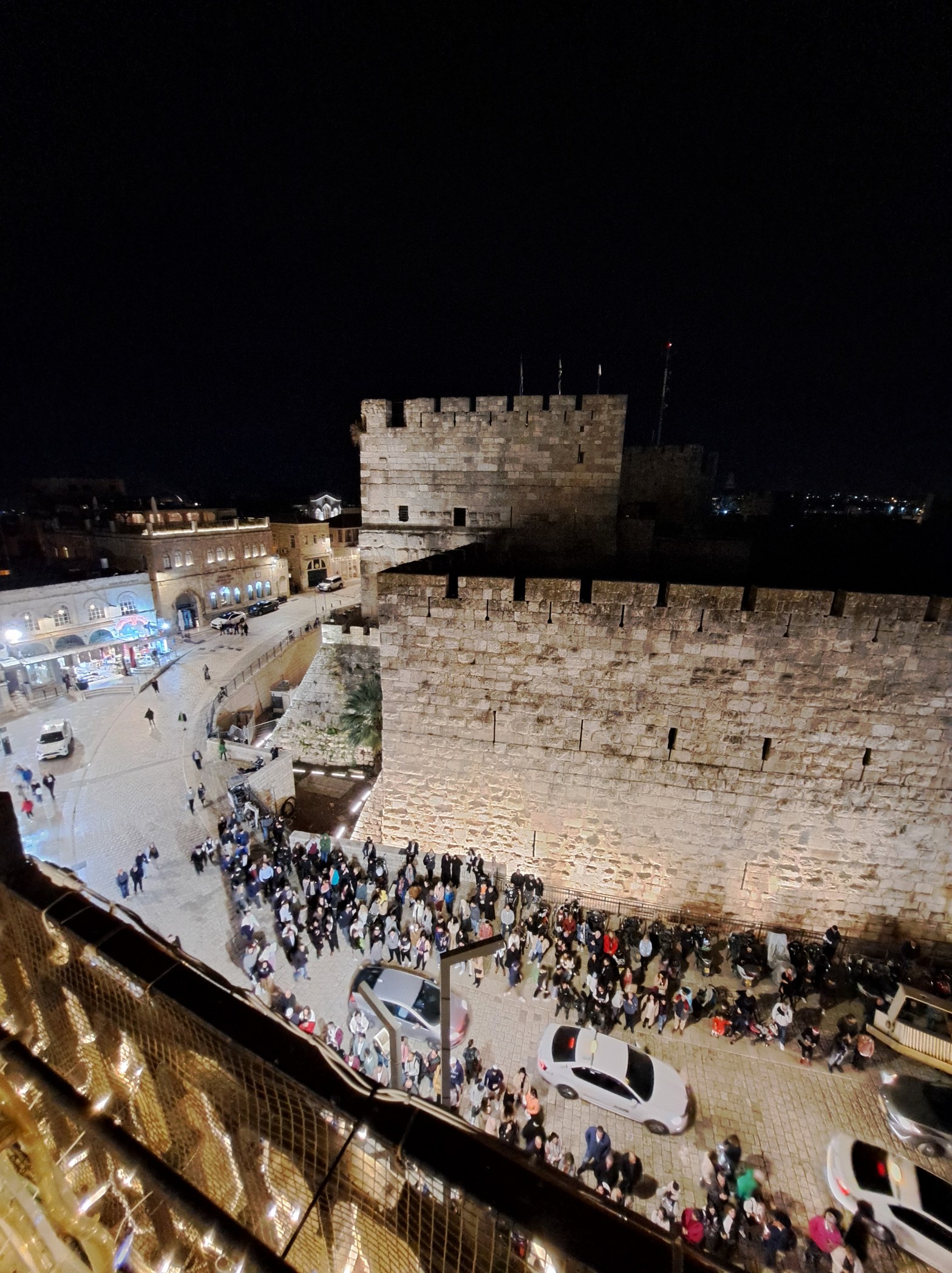
Outside, the old city continued its own version of the same compression. The covered walkways I described in my last post — no sky visible, centuries of buildings layered overhead — are lined with vendors selling religious artifacts and tourist trinkets and food, often in the same stall. A Jewish vendor selling menorahs next to a Christian vendor selling nativity sets next to a Muslim vendor selling prayer beads. Not in tension, exactly. In proximity. The proximity itself is the tension and the miracle simultaneously.
I went to the Wailing Wall. Long lines, many worshipers, prayers pressed into the cracks between the stones — the accumulated petitions of centuries, layer upon layer, the way the buildings themselves layer overhead. I stood and watched for a long time. There is something about witnessing that level of sustained, unbroken devotion — a people who have prayed at this wall through exile and return and destruction and rebuilding — that asks you to examine the quality of your own faith by comparison.
———
And then I walked through a gate and was in a Western shopping mall.
European restaurants. International hotel chains. A Pandora jewelry store where I bought Israel-specific pieces for my sister. The kind of place that could have been in any prosperous city on any continent. Five minutes from the Wailing Wall. Three minutes from the Church of the Holy Sepulchre.
I stood at the threshold between the old city and the new and felt the full strangeness of it. The world does not stop at the walls of Jerusalem. The ordinary presses right up against the extraordinary and neither cancels the other out. A Pandora bracelet charm stamped with a Star of David, purchased fifty yards from where generations of Jewish people have wept and prayed for two thousand years, slipped into a gift bag for my sister back in Florida.
The sacred does not require the ordinary to disappear. It just requires you to know which side of the gate you’re on. Where in your own life does the sacred and the ordinary press against each other — and how do you hold both without losing either?