
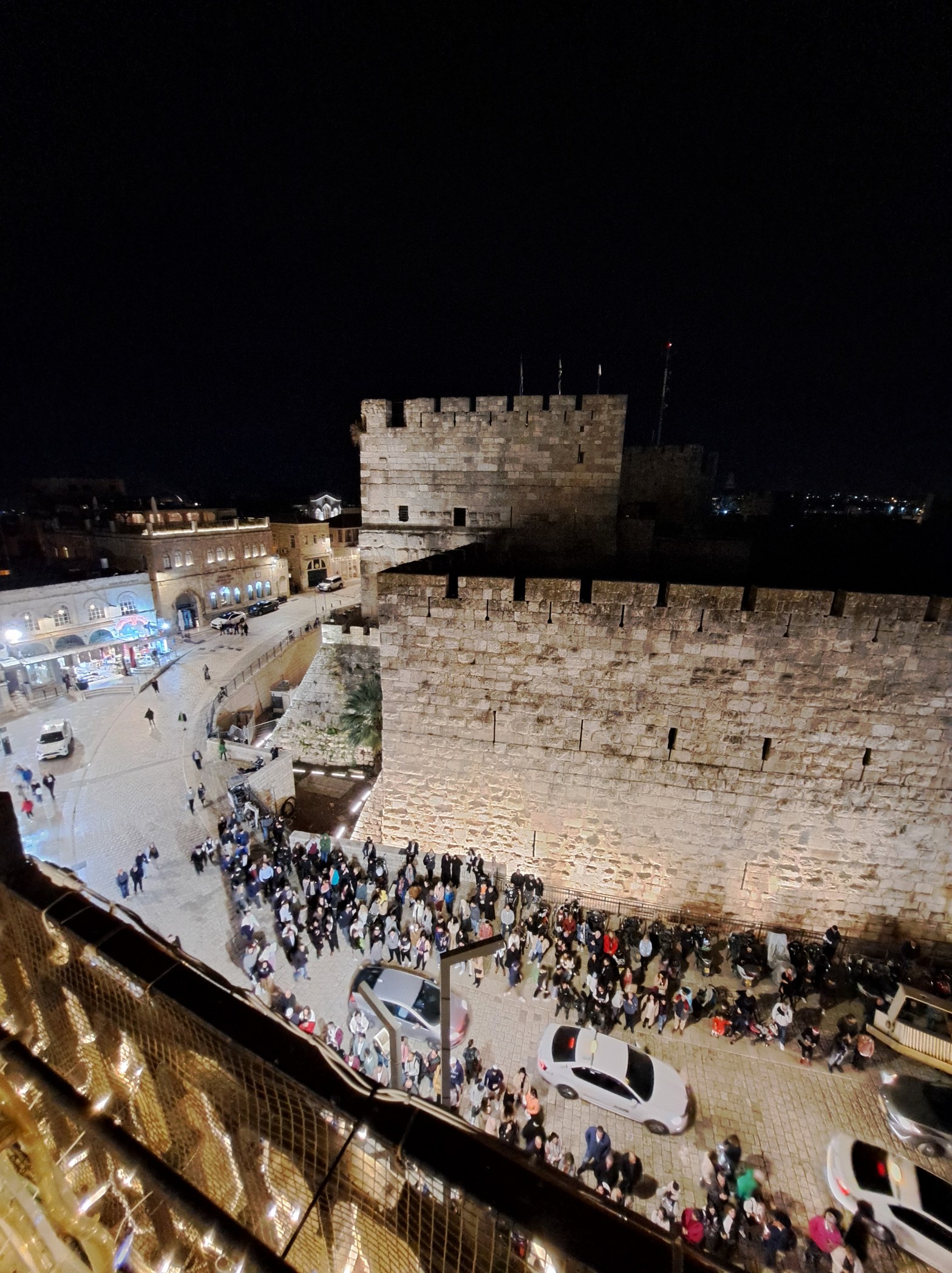
Five days in Jerusalem felt like weeks. Possibly months.
I have thought about why that is, and I keep returning to the same answer: time moves differently inside a story than it does in ordinary life. When you are a character in a narrative rather than an observer of one, each scene carries more weight. Each moment accumulates. The hours don’t pass — they deposit themselves.
I arrived in Jerusalem in December 2022 and did not know I was staying in the Christian quarter until I was already inside it. An Orthodox hotel, icons on every wall, a priest present at a function in the lobby. Outside the gate, close enough to hear from my room, a Christmas market — the kind you’d find in a German town square, with English carols floating through air that smelled of stone and candle wax. I half expected the sand on the sidewalks to turn to snow. It never did. But I kept expecting it.
I had not anticipated celebrating Christmas here. Not explicitly, not like this. And yet here was Christmas — the actual first Christmas, the city where the story began — dressed in German market stalls and English carols and Orthodox incense, all of it pressing against two-thousand-year-old walls in a city that has been claimed and reclaimed and converted and reconverted by every civilization that ever believed God was present in a particular place.
———
Walking through the covered walkways of the old city, I could not see the sky. The buildings layer upon themselves across centuries until the passages between them become tunnels, roofed by the accumulated weight of history. Jewish signs, Christian signs, Muslim signs. Jewish vendors, Christian vendors, Muslim vendors. Kosher restaurants alongside halal restaurants alongside ordinary ones. Synagogues, churches, mosques — sometimes sharing a wall, sometimes sharing a building, sometimes occupying the same building in sequence across different centuries.
The old city is small. If you know the way, you can cross it in minutes. What you cannot do is cross it lightly.
I felt, walking through those passages, that I was inside a Dickens novel. Not atmospherically — not just the stone and the lamplight and the carol singers. More than that. I could almost hear a narrator recounting the scenes as I moved through them. The old city of Jerusalem is a story being told in real time, written into the walls and the street pavers and the eyes of the people walking alongside you — their gestures, the weight they carry in their faces, the generational pain and the generational hope that coexist in this place without resolving into either.
Hope. Despair. Longing. Fulfillment. Joy. Generational pain. All of it present simultaneously, all of it alive, none of it finished.
I was not watching the story. I was in it.
———
This was different from what I had felt in Cairo, where I described time as a flip book — scenes from different centuries animating in the same coordinates while I ran my thumb across them. In Cairo I was still the observer. The Time Lord, stepping in and out of history, choosing which moments to pause at.
Jerusalem did not offer that distance.
In Jerusalem the narrator’s voice was present and the story was ongoing and I was a character in it, not a tourist of it. The distinction is hard to articulate precisely but I felt it immediately and have not been able to unfeel it since.
Every city has a history. Jerusalem has a Story. Capital S. One that is still being written, in real time, in a place where three of the world’s great faiths press against each other in cramped ancient streets under a sky you can barely see.
It felt, walking through it, like a tinderbox. Not with hostility — though the tensions are real and old and complicated. More with the compressed, pressurized weight of everything that has happened here and everything that people believe is still to come. Jerusalem is a city living simultaneously in its past and its future, with very little room for the present in between.
I walked through it for five days and came out the other side feeling as though I had lived there for a season. Have you ever walked into a place and felt, unmistakably, that you were inside a story larger than yourself?


